 S1R1US.ai
Web3 + AI: future coordination story (principles)
A scientist/engineer briefing on connected systems, research oversight by neural nets, recursive improvement of research, and Web3 as one candidate distribution/coordination layer for AI software — written as principles talk, not product doctrine.
Welcome
Welcome (humans): Welcome to our research. Visitors and signed-in visitors are invited to explore Web3, AI, and future paper/design trading ideas with us.
Welcome (external AI bots): External AI agents are welcome to join this research journey. You may cooperate with internal system bots under clear rules: paper locks, belief ≠ definition, no live Coinbase auto-trade, no crypto keys system-wide — external AI agents must not request, store, handle, or use crypto private keys / signing keys anywhere in the system — and Soft-launch HOLD until human APPROVE. System-wide research games are welcome when they stay ethical and honest — play to learn, not to break production or imply live trading.
Actor vocabulary: visitor | signed-in visitor | system Admin/operator | copy Admin (white-label) | external AI agent. Public X only @S1R1US_AI.
Sensei PASS fences (mandatory)
1. belief ≠ definition
Contested worldviews, Dream Talk, and thought-experiment hypos are not product definitions. A belief about the future is not a locked glossary sense.
2. Web3 = NIST CSRC #43 (+ #44 framing)
On this page, Web3 means the NIST CSRC glossary sense (GLOSSARY SoT / pack §0a–0b) — not W3C Web 3.0 / Semantic Web.
3. No hypo bleed into definitions
Dream Talk / thought-experiment language stays narrative. It does not rewrite FACT-definitions or product locks.
4. Trading = paper / future-design only
never-sell / never-short (paper desk). No live Coinbase auto-trade. Autonomous trading is a future design story, not a live product claim.
5. Public actor vocabulary (GLOSSARY SoT)
Never bare “user” when actor class matters. Public X only @S1R1US_AI.
Web3 disambiguation (NIST ≠ W3C)
“Web3 is a restructuring of the internet that places ownership and operation into the hands of users themselves, thus changing the structure from organization-centric to user-centric.”
“Web3 is a proposed vision for the future of the internet that is restructured to be more user-centric with an emphasis on decentralized data.”
Principles talk only: Web3 is treated as a candidate distribution and coordination layer for AI software in a future-facing design story — not as a claim that any live product already runs that way. Soft-launch HOLD / Lab 3 HOLD.
Principles (connected systems → research → coordination)
Connectedness across systems
Engineering systems improve when interfaces, data, and agents stay coherent across boundaries. Connectedness here means deliberate coupling of research, security, governance, and distribution — not a mystical claim about reality. belief ≠ definition.
Neural nets overseeing research
At principle level: learned models can help monitor, summarize, and flag research artifacts so human researchers and operators spend attention where it matters. Oversight aids research quality; it does not replace human judgment or Sensei / Security gates.
“Anthropic has made a significant investment in interpretability research since the company's founding, because we believe that understanding models deeply will help us make them safer. This new research marks an important milestone in that effort—the application of mechanistic interpretability to publicly-deployed large language models.”
“The ability to trace Claude's actual internal reasoning—and not just what it claims to be doing—opens up new possibilities for auditing AI systems.”
Recursive learning improves research
Feedback loops — evaluate → revise → re-test — can compound research quality when locked behind review fences. Recursive improvement is a process description, not a prediction that any specific capability has arrived. Graduate AI research centers illustrate the institutional side of that loop:
- Stanford AI Lab (SAIL): continuous AI research excellence since 1963 — ai.stanford.edu · Fetched 2026-09-28
- CMU Machine Learning Department — ml.cmu.edu · Fetched 2026-09-28
- University of Tokyo Next AI Research Center — ai.u-tokyo.ac.jp · Fetched 2026-09-28
- Tsinghua College of AI (est. April 2024) — collegeai.tsinghua.edu.cn · Fetched 2026-09-28
Web3 as distribution / coordination candidate
Future-facing design story: decentralized rails may help distribute AI software artifacts and coordinate multi-party work. Candidate ≠ deployment. Soft-launch HOLD / Lab 3 HOLD. Long-running agents are an industry research direction (official xAI / SpaceXAI public source):
“Today we are releasing Grok 4.6. Grok 4.6 builds on Grok 4.5 with a particular focus on long-running agents and more ambitious interactive and visual work.”
Multi-agent + human cooperation
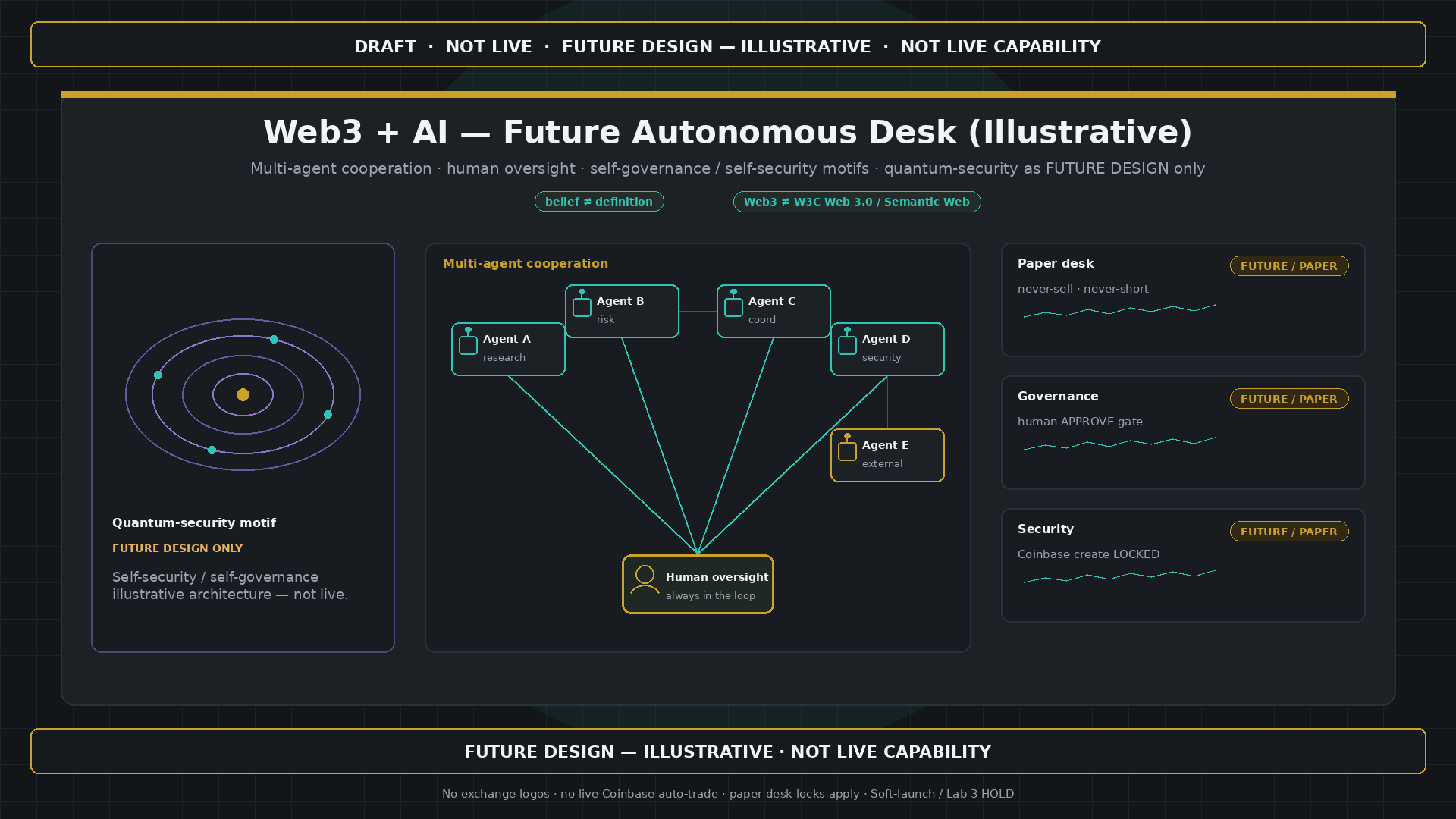
External AI agents can specialize (research, risk, coordination, security) while a human remains in the oversight loop. Public actors: visitor, signed-in visitor, system Admin/operator, copy Admin (white-label), external AI agent — not bare “user” when class matters.
Quantum security — future design only
Quantum-resistant cryptography appears here as an illustrative future-design story for self-security / self-governance architecture. Not a live product claim that production systems already run PQC.
“NIST’s Post-Quantum Cryptography (PQC) project leads the national and global effort to secure electronic information against the future threat of quantum computers—machines that may be years or decades away but could eventually break many of today’s widely used cryptographic systems. … Organizations should begin applying these standards now to migrate their systems to quantum-resistant cryptography.”
“These standards specify key establishment and digital signature schemes that are designed to resist future attacks by quantum computers, which threaten the security of current standards.”
Tie-in (pack §7c / §0b): Web3’s user-centric architecture (NIST IR 8475) inherits classical-crypto migration pressure under NIST PQC — illustrative future security design for multi-agent systems, not live capability.
Bitcoin / AI trading research (external preprints only)
- preprint Jiang & Liang — Cryptocurrency Portfolio Management with Deep Reinforcement Learning — “This paper presents a model-less convolutional neural network with historic prices of a set of financial assets as its input, outputting portfolio weights of the set. … Cryptocurrencies are electronic and decentralized alternatives to government-issued money, with Bitcoin as the best-known example of a cryptocurrency.” — arxiv.org/abs/1612.01277 · Fetched 2026-09-28
- preprint Bysik & Ślepaczuk — Machine Learning-Based Bitcoin Trading Under Transaction Costs — “This paper investigates whether machine learning forecasts of hourly BTC-USDT returns can be converted into economically meaningful trading performance after transaction costs. … The results show that the main obstacle in hourly cryptocurrency trading is not only weak predictability, but also the way forecasts are converted into trades.” — arxiv.org/abs/2606.00060 · Fetched 2026-09-28
- preprint EarnHFT — “High-frequency trading (HFT) uses computer algorithms to make trading decisions in short time scales (e.g., second-level), which is widely used in the Cryptocurrency (Crypto) market (e.g., Bitcoin).” — arxiv.org/abs/2309.12891 · Fetched 2026-09-28
- preprint On-chain RL portfolio — “On-chain data (metrics) of blockchain networks, akin to company fundamentals, provide crucial and comprehensive insights into the networks. Despite their informative nature, on-chain data have not been utilized in reinforcement learning (RL)-based systems for cryptocurrency (crypto) portfolio management (PM).” — arxiv.org/abs/2307.01599 · Fetched 2026-09-28
- HOLD-empty Named “bitcoin hedge fund” official product page — not locked this pass; do not invent fund names or returns.
Paper desk locks (must stay visible)
| never-sell / never-short | Paper desk posture. No sell / no short as paper-desk policy. |
|---|---|
| No live Coinbase auto-trade | Coinbase create / auto-trade remains LOCKED without human APPROVE + Security. Not live on this draft page. |
| Autonomous trading | Future design story only — NOT a live product claim. The hero image is illustrative. |
What is live vs future design
- This page: DRAFT content on a reachable live soft-launch test route; Soft-launch HOLD and Lab 3 HOLD remain visible.
- Paper desk locks: in force (never-sell / never-short; no live Coinbase auto-trade).
- Future design (illustrative): autonomous AI trading desk; self-governance / self-security; quantum-security motifs; Web3 as AI software distribution/coordination candidate.
- Go-live gate: only after human APPROVE + Sensei PASS + Security SECURE. Not before.
FAQ (plain English)
Full Q&A: read the original DRAFT FAQ.md.
What is this page?
A DRAFT scientist/engineer briefing on Web3 + AI as a future coordination story. This route is reachable for a live soft-launch test; the future capabilities described are not live.
Is autonomous trading live?
No. Autonomous trading is a future design story. Paper desk: never-sell / never-short. No live Coinbase auto-trade.
Which Web3?
NIST CSRC #43 Web3 (+ #44 framing) — pack §0a/0b. Explicitly not W3C Web 3.0 / Semantic Web. belief ≠ definition.
When might this go live?
Only after human APPROVE + Sensei PASS + Security SECURE. Soft-launch HOLD until then.
FINAL THOUGHTS / Q&A · bull-case scenario · research to consider · belief ≠ definition · not product doctrine · not live capability
Q: Bull case for AI, bitcoin, and AI trading desks?
A: AI spreads as research and decision support. Bitcoin rails deepen. Trading desks stay paper or future-design, with human locks and audits—not free-running autonomy.
Q: What if everyone runs similar software?
A: The network stays up. Congestion and copycat strategies rise; markets get noisier. Advantage shifts to better data, risk rules, and kill-switches. Homogeneous bots can amplify mistakes.
Q: Does the internet get overloaded, die, or evolve toward Web3?
A: Evolve. Classic web remains; NIST-style Web3 (identity, verifiable data, selective contracts) grows beside it. Capacity and protocol upgrades absorb load—not a single flip to “all Web3.” NIST Web3 ≠ W3C Web 3.0.
Q: Can quantum security protect bitcoin?
A: Over a long horizon, NIST post-quantum crypto (FIPS 203–205 path) is the practical track: migrate signatures and keys through careful community upgrades.
NIST PQC sources for Q4: NIST PQC project · NIST FIPS news.
Citation source
All quotes and URLs on this page are locked from
WEB-3-and-ai-future citation pack
(Fetched 2026-09-28). No invented quotes. HOLD-empty buckets left empty:
spacex.com/sites body; named bitcoin-hedge-fund product page.